
U.S-Based Expert Support
M–F 9a–5p EST
M–F 9a–5p EST
The best braces for Ehlers-Danlos syndrome match each loose joint: hinged braces stop knees and elbows from bending back, sleeves improve joint sense, and belts steady the pelvis. This guide covers EDS braces, also called hypermobility braces, joint by joint so you can choose with confidence.

A brace adds outside support where loose ligaments can't hold the joint in place.
Support takes some load off the muscles that work overtime to guard hypermobile joints.
Stops and straps limit the motions that make knees, ankles and shoulders slip.
Living with hypermobile joints means planning around the ones that slip, ache or give way. The right brace won't change your collagen, but it can make walking, working and sleeping steadier.
Our brace specialists help customers choose support one joint at a time. This guide shares that approach, with picks for each body area and honest advice on when to see a doctor.
Ehlers-Danlos syndrome (EDS) is a group of inherited conditions that affect connective tissue. Connective tissue holds your joints, skin and blood vessels together, and collagen gives it strength. When collagen is weak or built differently, ligaments stretch too far and joints move past their normal range.
According to MedlinePlus Genetics from the National Library of Medicine, the 2017 classification describes 13 types of EDS. Together, they affect at least 1 in 5,000 people worldwide. Hypermobile EDS (hEDS) is the most common type, notes Cleveland Clinic, and it is the type most people mean when they talk about EDS bracing.
Loose joints can slip partly out of place (subluxation) or fully out of place (dislocation). Muscles try to make up for loose ligaments, which leads to fatigue and soreness. The advice in this guide also applies to hypermobility spectrum disorder (HSD).

EDS is genetic, so you are born with it, even if symptoms show up later. The joint problems come from three things working together.
Changes in the genes that build collagen make ligaments and joint capsules looser than normal.
Ligaments can't hold the joint steady, so it slides or bends too far under everyday loads.
Muscles take over the job ligaments can't do, so they tire, ache and react more slowly.
See your doctor if a joint dislocates, if you have new numbness or weakness, or if pain keeps you from daily tasks. Diagnosis usually needs a specialist, such as a geneticist or rheumatologist. A brace supports a loose joint; it doesn't change the collagen or treat EDS itself.
Hypermobility braces help anyone whose joints move too far or slip during normal activity.
Braces add outside support while you build strength in physical therapy.
A brace can steady a shoulder, kneecap or thumb that slips during reaching, walking or sleep.
A hinged brace with a stop keeps the knee from snapping back past straight.
An SI belt squeezes the pelvis together when loose ligaments let it shift.
Pregnancy loosens joints further, and an SI belt can ease pelvic strain.
Compression sleeves and lace-up braces support exercise, travel and long days on your feet.
A brace does part of the job your ligaments can't do. Cleveland Clinic lists wearing braces for extra joint support alongside physical therapy to strengthen the muscles around your joints. Braces help in three main ways.
Hinges, stops and straps limit the last few degrees of movement, where loose joints slip or bend back.
Snug compression gives your brain more feedback about where the joint is, so you can react sooner.
Collars, splints and belts hold a joint steady during flares, travel or rest, so muscles can relax.
Experts are careful about how braces are used. The Ehlers-Danlos Society notes that splints and braces are sometimes used to protect joints, and that research on long-term hand and wrist splinting is limited. That is why most people use braces for specific tasks and flare days, not around the clock.
EDS support braces fall into five groups. Many people use more than one type, matched to each joint and each activity.
Metal or plastic hinges with stops that keep a knee or elbow from bending back too far.
Knit or elastic sleeves that hug the joint for light support and better joint sense.
Figure 8 straps and laces that limit rolling, mostly for ankles and wrists.
SI belts and shoulder stabilizers that hold the pelvis or shoulder in a steadier position.
Soft collars, wrist splints and thumb splints for rest and short periods of support.
A compression sleeve and a hinged brace solve different problems. A sleeve gives light, even pressure and better joint sense, but it has no stop, so it can't block a knee that bends back. A hinged brace has a mechanical stop, so it controls motion, but it is bulkier and warmer.
Many people with EDS own both. They wear a sleeve on good days, then switch to a hinged brace for long walks, hills, stairs or flare days.

The best knee brace for EDS depends on how your knee moves. If it snaps back past straight when you stand or walk downhill, called hyperextension or genu recurvatum, you need a brace with a stop behind the knee. A sleeve alone won't block that motion.
Hyperextension braces use a hinge, strap or air bladder at the back of the knee to stop the last unsafe degrees of straightening. You can still bend the knee freely. If your knee feels loose or achy but doesn't bend back, a knit compression sleeve is often enough.


For most people with EDS, the best hip brace is an SI belt. The sacroiliac (SI) joints connect your spine to your pelvis and carry your upper body weight. When their ligaments are loose, the pelvis can shift, causing sharp pain in the low back, buttock or hip.
An SI belt wraps low around the hips, below the waist, and squeezes the pelvis together. Many people feel steadier walking, standing and climbing stairs while wearing one. True hip instability inside the ball and socket joint needs a doctor's exam, because rigid hip braces are mainly used after surgery.


The shoulder is the most mobile joint in the body, so it is often the first to slip with EDS. Hypermobile shoulders can sublux when you reach, lift, carry bags or roll over in bed. The right EDS shoulder brace supports the joint while still letting you use your arm.
A shoulder stabilizer holds the top of the arm up and into the socket with straps around the arm and chest. A compression style brace hugs the joint for feedback and light support during activity. Slings and immobilizers hold the arm still, so save them for after a dislocation or surgery, as your doctor advises.


A soft neck brace can help with EDS for short periods. Loose neck ligaments let the vertebrae shift, and the muscles that hold your head up work overtime. Many people describe a heavy head, headaches at the base of the skull and neck muscle spasms.
A soft foam collar gives the neck muscles a rest during flares, long car rides or desk work. Wear it for short stretches, then take it off and move gently, because constant wear can let neck muscles weaken.
See a specialist if you have numbness or tingling in your arms, vision changes, trouble swallowing or severe headaches at the base of your skull. These can be signs of craniocervical instability (CCI), which needs medical evaluation, not a soft collar.
Read our neck brace guide →
Loose ligaments along the spine can make the low back ache after standing and let the upper back round forward. Back braces for hypermobility work best for specific tasks, such as long drives or lifting. For pain low in the back or buttock, see the SI belt section above first.
Posture braces pull the shoulders back gently and remind you to sit tall. Think of one as a cue, not a fix, and build the muscles between your shoulder blades.
Some people with EDS have ribs that shift or click, or painful rib cartilage (costochondritis). An elastic rib belt gives gentle compression during flares. Always see a doctor about new chest pain.
Read our posture and back brace guide →Loose ankle ligaments let the foot roll in or out on curbs, grass and gravel. Each twist can stretch the ligaments further, so many people with EDS walk carefully and avoid uneven ground. A supportive ankle brace adds the stability the ligaments are missing.
Lace-up braces with figure 8 straps work like athletic tape you don't have to redo. The straps wrap under the heel and across the ankle to limit rolling while still letting you point and flex the foot. Most fit inside a sneaker or lace-up shoe.


Hypermobile wrists bend back when you type, push up from a chair or carry a bag. That strain can irritate tendons and nerves, causing aching, weakness or carpal tunnel-like tingling. A wrist brace holds the joint in a neutral position so the tendons get a rest.
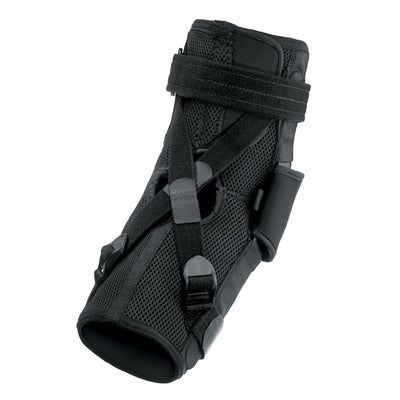
Elbows can also snap past straight when you push a door or lift. A wrist brace for EDS is usually worn during heavy hand use or at night. An elbow brace with adjustable hinges limits how far the arm straightens while still letting it bend.
The joint at the base of the thumb is often loose in hEDS, which can make gripping and opening jars painful. A thumb spica splint steadies that joint while leaving the fingers free.


EDS skin bruises easily and can react to materials that don't bother other people. These habits help.
Begin with short sessions and add time as your skin and muscles adjust. Use braces for the tasks that cause trouble, not every waking hour.
Wear a thin cotton or moisture-wicking layer under the brace. Choose breathable knit or mesh when heat and sweat bother you, since neoprene holds heat.
Look at your skin each time you take the brace off. Red marks that don't fade quickly, bruising or blisters mean the fit or tension needs changing.
The Ehlers-Danlos Society advises that strengthening exercises should be carefully taught and graded. Pair your braces with a physical therapy plan so your muscles keep getting stronger.
Many EDS braces, from hinged knee braces to SI belts, have an HCPCS code, the billing code Medicare and insurers use for medical equipment. We don't bill insurance, but you can submit your receipt to your insurer for possible reimbursement. Most of our braces are also HSA and FSA eligible.

US-based team, Monday to Friday
Not sure which braces fit your EDS? Tell us which joints slip or bend back, when it happens and what your therapist has said. Our specialists can help you choose a size and style before you buy, and after your brace arrives you can use our fitting videos or book a virtual fitting session.
Unused items in their original packaging can be returned or exchanged within 30 days of purchase. See our Return Policy for details.
Contact Our TeamYes, braces can help many people with EDS by adding outside support to loose joints. Cleveland Clinic lists braces for extra joint support as part of EDS care, along with physical therapy.
Suggested: OrthoPro HyperEx Knee Brace or Brace Align GlideFit SI Belt
A knee brace with a hyperextension stop is the best choice when your knee bends back past straight. It blocks the last unsafe degrees of straightening while letting you bend normally. For knees that feel loose but don't bend back, a knit compression sleeve is often enough.
Suggested: OrthoPro HyperEx Knee Brace or Bauerfeind GenuTrain Knee Brace
A shoulder stabilizer or compression style shoulder brace helps most, because it supports the joint while you keep using your arm. Slings and immobilizers hold the arm still and are mainly for after a dislocation or surgery.
Suggested: Ottobock Shoulder Stabilizer or Bauerfeind OmoTrain S Shoulder Brace
For most people with EDS, an SI belt is the best hip brace. It wraps low around the hips and squeezes the pelvis together when loose SI joint ligaments let it shift. Pain deep in the hip joint itself should be checked by a doctor.
Suggested: Brace Align GlideFit SI Belt or Aspen Evergreen 621 Sacroiliac Support Belt
A soft neck brace can help for short rest breaks during flares, travel or desk work. Long, constant wear can let neck muscles weaken, so take it off and move gently between uses. Arm numbness, vision changes or severe headaches at the base of the skull need a doctor's visit.
It can if you wear a brace all day for long periods and stop exercising. Use braces for the tasks and days that need them, and keep up the graded strengthening program from your physical therapist. The brace and the exercise work together.
Wear a compression sleeve for light support and better joint sense, and a hinged brace when a joint hyperextends or gives way. Sleeves have no stop, so they can't block a knee or elbow from bending back.
Suggested: Bauerfeind GenuTrain Knee Brace
We don't bill insurance, but you can submit your receipt to your insurer for possible reimbursement. Most of our braces are HSA and FSA eligible, and your insurer may ask for a prescription.